

When I attended a national conservative gathering not long ago, I sensed that something real was stirring. There was talk of restoring order, recovering national purpose, and strengthening the family. Those instincts are not wrong, but they are incomplete. What we need is not merely a renewed political coalition or a revived voting bloc; we need a new moral majority, and, as the name suggests, it must be profoundly moral in substance. My argument is that the moral majority must have the Church at the very center of its mission.
The old Moral Majority, for all its energy and influence, mistook the fruit for the root; it sought cultural transformation without sufficiently grounding that transformation in the ecclesia. But if Church and worship are disoriented, society loses its capacity to function with any real order. The answer to our cultural decay is not first political; it is ecclesiastical.
The Church is not an accessory to public life; she is the genesis of a moral vocabulary shaped by the Sacred Scriptures. Without her, we do not merely lose transcendence; we lose definition. If we no longer know what a woman is, it is because the Church has failed to catechize the world in the grammar of creation. That failure is not accidental; it is theological, liturgical, and ecclesial.
For too long, the Church has played nice; she has sought to minimize offense and, in doing so, has forfeited her voice. When asked whether we are too polarized, the instinct is to lament division, but the deeper problem is that we are not polarized enough. The Church has refused to show up for the family portrait. Instead, she has become the distant relative, present at formal ceremonies and absent from formation. Yet she must be present; not merely present, but central in the formation of the culture around us.
The Idol of Individualism and the Silence of the Church
A new moral majority will not emerge from think tanks or campaign platforms; it will emerge from pulpits and tables, from Word and Sacrament, from a people shaped week after week by the rhythms of worship. The Church is the paradigmatic institution; she does not borrow her authority from the state, rather the state borrows its legitimacy from a moral order that the Church proclaims.
The great obstacle to this vision is not first external opposition; it is internal corruption. The modern Church has been catechized by individualism; this spirit has turned her inward, privatized her mission, and reduced her to a therapeutic community of self-expression. And as Carl Trueman has observed, “the modern self assumes the authority of inner feelings to define what is real.” That is the social imaginary in its purest form; a world in which identity is no longer received from God but constructed from within. When the Church refuses to confront that assumption, she quietly baptizes it.
In this social imaginary, the self becomes the arbiter of truth; reality is no longer received, it is constructed. The Church, instead of confronting this rebellion, has often accommodated it. She has embraced a navel-gazing pietism and mistaken introspection for holiness. But a Church that does not speak to the nations is a Church that has forgotten her calling.
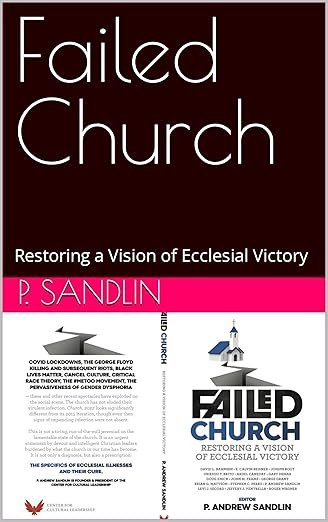
This was made clear in recent years. When crisis came, many churches relinquished the corporeal necessity of worship; they traded the gathered assembly for digital substitutes. The result was predictable; a de-churched Church. When liturgical bones are not exercised, they atrophy; when the Church ceases to practice her story, she forgets who she is (see my essay in “Failed Church” edited by Andrew Sandlin).
What followed was not neutrality; it was silence. And that silence bore fruit; instead of forming a people resistant to tyranny, many churches surrendered their sacred time and their sacred practices. The consequence is a Church unsure of her authority and hesitant in her witness.
The Rise of an Ecclesial Majority
A new moral majority must begin with a renewed commitment to worship; the first day of the week must again become central for the formation of political thinking and cultural engagement. Before we are citizens, we are worshipers; before we engage the public square, we ascend the heavenly one.
Ecclesial conservatism begins here; we think first as churchmen and only then as citizens. Our loyalty is first as worshipers; the political flows from the liturgical, not the reverse. We refuse to place the civic calendar above the Christian calendar; we will not allow the flag to eclipse the cross or the pledges of men to replace the creeds of the Church.

This vision restores prayer to its rightful place; not as a sentimental or even pietistic way of approaching God, but as action. The Church must pray for her leaders as Scripture commands; not as a formality, but as a means of shaping reality. Prayer is not withdrawal. At the very center, it is engagement at the deepest level.
Further, this ecclesial majority does not flee politics; it redeems it. It rejects the secularism that divorces faith from public life and the reductionism that makes politics ultimate. This is not a call to revolution by arms; it is a call to revolution by armor. The Church advances through worship, hospitality, feasting, and faithfulness; she forms a people whose life together embodies an alternative society, a foretaste of the kingdom of heaven.
The public square is indeed a battleground of the gods, but Christians have too often entered that battlefield unarmed, having neglected the very means by which God forms his people. The result has been confusion, compromise, and defeat. What we need, then, is not merely a louder conservative movement; we need a holier Church. Not merely a stronger voting bloc, but a stronger ecclesia. Not merely a moral majority, but a moral-moral majority, a people whose morality is not borrowed from tradition alone, but generated from the living worship of the Triune God.
The Church must once again become the beating heart of cultural renewal; she must sing again with angels and archangels, proclaim again the unchanging Word, and gather again as the visible society of God’s redeemed people.
Only then will a true moral majority emerge: not as a political accident, but as the inevitable fruit of a faithful Church.