

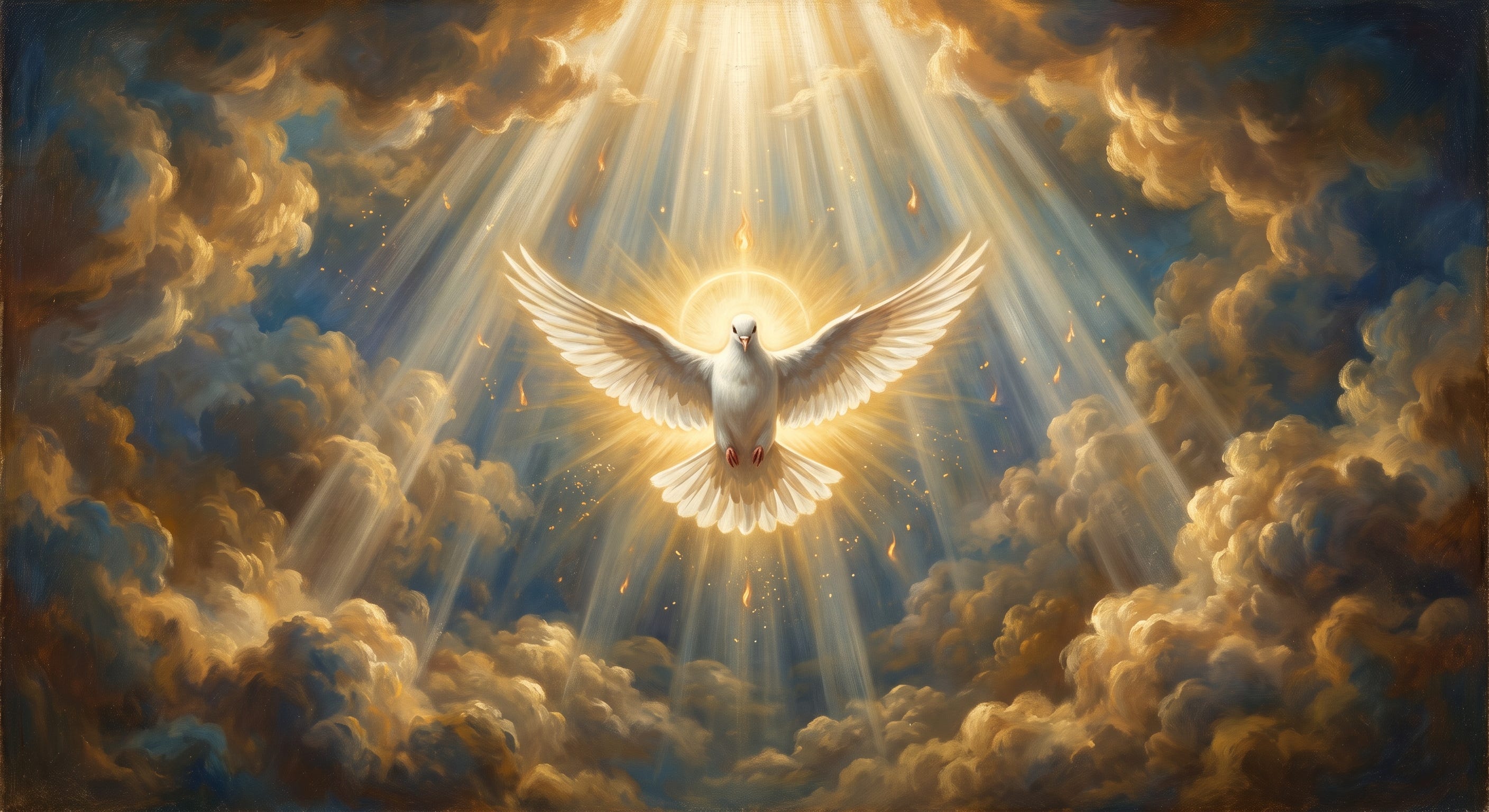
Have you ever wondered why the Holy Spirit is called the Holy Spirit? We are to baptize into the name of the Father, Son, and Holy Spirit (Mt 28:19). Why not the “Holy Father” and “Holy Son” as well? Every member of the Trinitarian Family is holy, but rarely is the adjective “holy” attached to the Father and Son. However, it is frequently attached to the Spirit.
The reasons for this are many, and there are some, I’m sure, that I don’t know. But names are not given without purpose. In some of Jesus’ last words to his disciples in John 14, after calling the Spirit the Paraclete, he calls him “the Holy Spirit” (Jn 14:26). Names in Scripture describe someone’s mission. Jesus is named “Jesus,” for example, “because he will save his people from their sins” (Mt 1:21). Jesus means “Yahweh is salvation.” When Jesus calls the Spirit “the Holy Spirit,” he is not only telling us who he is in his Person, but also his mission.
What does it mean to be “holy?” Holiness speaks of purity or integrity. (Unfortunately, people have said that it means “separation” or “otherness,” but that is only in the presence of sin. God is eternally holy. He is holy before the creation of the world and, therefore, before sin and separation or otherness from anything.) Being the Holy Spirit distinguishes God’s Spirit from evil spirits. Evil or unclean spirits in Scripture are agents of chaos, disorder, and death. They are impure and create impure environments. What they are in their persons is revealed in what they do. The Spirit of God, however, is holy in himself, and he creates holy environments. He is pure and creates purity. He is integrous and creates integrity.
We see the Spirit’s holiness in his original creation work. He broods over the formless, void dark waters and brings integrity to them. That which was disordered is ordered in accordance with his character and is declared “good.” He creates right relationships, bringing peace.
When Jesus sends the Holy Spirit, he will create a holy people, which will also be a holy environment. He will create us to be a dwelling place for God, uniting us to the Son in whom the Father dwells. He creates bonds. He does so as the bond of love eternally between the Father and the Son (for he is the Spirit of the Father and the Son). He also binds us to the Father in the Son. He also binds us together as the church (1 Cor 12:12-13). The church is a holy environment, fit for God’s dwelling place.
Because the Spirit unites us to the body of Christ–we are in Christ–we are positionally holy. But he also creates a holy environment for the Father and the Son by making us progressively holy. That is, he changes us over time so we become holy as God is holy; we come to share the integrity of God’s character because of the work of the Spirit.
Holiness emphasizes who he is in his mission. “Spirit” emphasizes his power. While “spirit” does connote his immateriality, Scripture stresses energy and activity. As Sinclair Ferguson notes in his (highly recommended) book, The Holy Spirit, “The emphasis is, rather, on his overwhelming energy; indeed one might almost speak about the violence of God.” (17) The Holy Spirit is the power of God to create holiness.
If you are a member of Christ’s church, you are in the holy environs created by the Spirit and are therefore expected to walk in step with the Spirit (cf. Gal 5:25). You are not to grieve him through sin, especially sins that create divisions in the body of Christ. You are to work with him to create integrity, health, wholeness, or peace within the body of Christ.
Walk in the Spirit.